Friday night. 8:00PM. Somewhere outside of Austin.
Don’t sleep.
IT’S hard to imagine a film that’s been written about more and seen less than “The Passenger.” One of the enigmatic masterworks of modern cinema, the 1975 Michelangelo Antonioni movie has been out of circulation for years — it’s never been on DVD and was only briefly available on video in the mid-1980s. But thanks to Sony Pictures Classics, the film opens Nov. 4 for a weeklong run at the Nuart, with a DVD release to follow early next year.
Actually, the real thanks go to Jack Nicholson, who not only stars in the film but is its longtime owner, having acquired the picture from MGM in a settlement with the studio after a film Nicholson had been hired to star in fell apart. He had kept “The Passenger” off the market until Sony persuaded him that they would give it a classy send-off. For years, critics have swooned over the film, writing themselves into knots grappling with the movie’s portrayal of a man’s struggle with spiritual ennui. But having spent months making the film in a variety of locations, notably Barcelona, London and the remote desert of Algeria, Nicholson has vivid memories about the making of the film, especially the weeks he spent in the desert, three days away from the nearest city.
“I’ve never been that far from civilization, before or since,” he told me the other day, sitting in the living room of his house, waiting for a baseball playoff game to begin. “We lived in thatched huts out in an oasis in the middle of the Sahara desert. It wasn’t unusual to have these huge sandstorms where everything would be covered with this fine pink sand. I can still see Michelangelo walking in the sand, with the wind blowing, picking out shots that he wanted to get.”
Nicholson makes it sound more like an adventure than arduous work. “It only takes a day to get used to the flies on your nose,” he said, lighting the first of three cigarettes he has carefully lined up on a coffee table. “The Italian crew was serious about eating, so we’d have good food every night, get high and look up at the sky. The first night felt very eerie, because it was so quiet. I didn’t know it at the time, but it was the most vivid filmmaking adventure I’ve ever had.”
It’s a sign of Nicholson’s affection for Antonioni that the actor, who couldn’t be bothered with doing interviews when he was up for an Academy Award for “About Schmidt,” spent 90 minutes recounting his friendship with the legendary filmmaker. As Nicholson put it, “He’s been like a father figure to me. I worked with him because I wanted to be a film director and I thought I could learn from a master. He’s one of the few people I know that I ever really listened to.”
It seems eerie that the man whose films are filled with examples of our inability to communicate with each other has largely lost his own power of speech. Now 93, Antonioni is confined to a wheelchair and largely mute, the result of a stroke some years ago. Still the filmmaker continues to work and flew to Los Angeles last month for a showing of “The Passenger,” which has six minutes of footage cut from the original U.S. release. The day after the screening, Nicholson had the director up to his house, a visit that illustrated how, even in old age, Antonioni has lost little of his playful spirit.
Knowing that Nicholson is an avid art collector, Antonioni asked to see his new paintings. “He’d say, ‘What’s upstairs?’ so I’d go up and down the stairs, bringing all the art down for him to look at,” Nicholson recalls. “Then, after I’d lugged everything downstairs, he said, ‘OK, let’s go upstairs.’ ” Nicholson laughs. “I knew if I challenged him, he’d say, ‘It would be good exercise for you.’ ”
“The Passenger” was the third film in a three-picture deal Antonioni had with MGM. The deal started with a bang, with “Blow-Up,” the director’s biggest hit, but his next film, “Zabriskie Point,” was a huge bust. Having Nicholson, who’d just appeared in “Chinatown,” starring in his next project surely helped Antonioni protect his artistic independence.
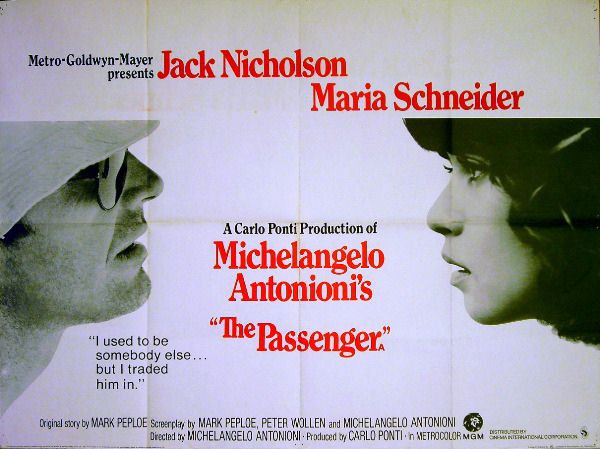
In the film, Nicholson plays a burned-out TV journalist trying to locate a band of guerrilla fighters in North Africa. When a man at his hotel suddenly dies, Nicholson’s character assumes his identity, journeying across Europe after discovering that the man had been supplying guns to the guerrillas. The storyline is reminiscent of a Graham Greene novel, but in Antonioni’s hands, it is less a thriller than an existential-style mediation on identity and alienation. When Nicholson’s character meets a beautiful stranger, played by Maria Schneider, she asks who he is. “I used to be somebody else,” he says. “But I traded him in.” The film concludes with a dazzling seven-minute shot that, in its way, is as much a bravura piece of filmmaking as the opening sequence in Orson Welles’ “Touch of Evil.”